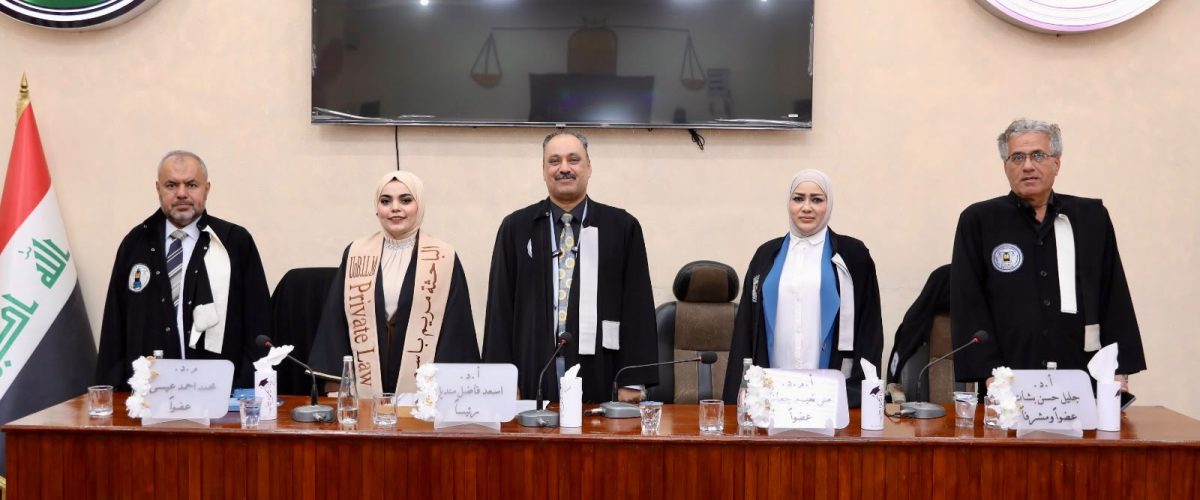

The College of Law at the University of Baghdad discussed a Master’s thesis entitled “The Applicable Law and the Competent Court in Artificial Intelligence Disputes,” submitted by Maryam Basim Qasim, a student in the Department of Private Law, on Monday, July 6, 2026, in the College’s Conference Hall.
The examination committee consisted of:
- Prof. Dr. Asaad Fadhel Mandil – Chairman
- Assist. Prof. Dr. Mona Naeem Jaaz – Member
- Lect. Dr. Mohammed Ahmed Issa – Member
- Prof. Dr. Jaleel Hassan Bshat – Member and Supervisor
The thesis aimed to examine the legal rules governing the determination of the applicable law and the competent court in artificial intelligence disputes. It also assessed the extent to which traditional private international law rules are capable of addressing the unique characteristics of cross-border AI disputes, with the objective of proposing a legal framework that promotes legal certainty and provides effective protection for the parties involved.
The thesis consisted of two chapters. The first chapter examined the applicable law and the competent court in AI disputes arising from contractual liability, while the second chapter focused on the applicable law and the competent court in AI disputes arising from tort liability.
The thesis concluded with several recommendations, the most significant of which include:
- Recommending that every smart contract concluded on a blockchain network be accompanied by a written agreement in plain natural language, set out in a parallel document specifying the applicable law and the competent court. In the event of any inconsistency between the smart contract and the written document, the provisions of the written document should prevail.
- Proposing an amendment to the Judicial Organization Law to establish specialized divisions within the commercial and civil courts, to be known as “Smart Technology Disputes Divisions,” dedicated to adjudicating artificial intelligence disputes. These divisions should be assisted by technical experts capable of understanding and analyzing the programming code at issue.
-
Recommending the conclusion of an international convention on private international law relating to artificial intelligence to address the legislative gap in cross-border AI disputes. The proposed convention should ensure a balance between protecting injured parties and encouraging innovation by harmonizing conflict-of-law rules and rules of international jurisdiction.