
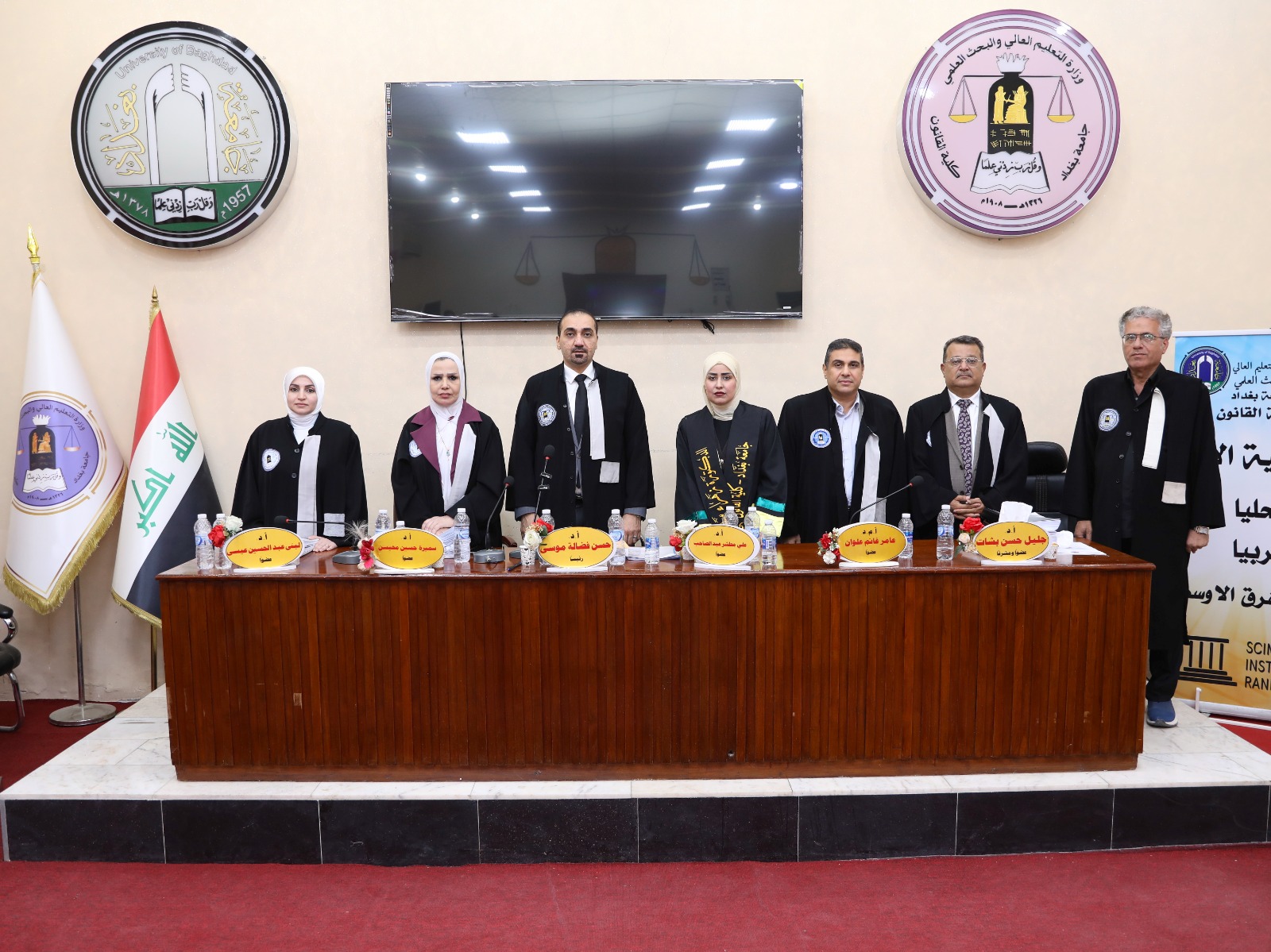
The College of Law at the University of Baghdad discussed a PhD dissertation entitled “The Impact of Custom in Contracts: A Comparative Study”, submitted by Zahraa Salman Anad, a candidate in the Department of Private Law, on Monday, 22 June 2026, in the College’s Conference Hall.
The examination committee consisted of:
1. Prof. Dr. Hassan Fadhala Mousa – Chairman
2. Prof. Dr. Ali Mutashar Abdul Sahib – Member
3. Prof. Dr. Samira Hassan Muhsin – Member
4. Prof. Dr. Lubna Abdul Hussein Issa – Member
5. Assist. Prof. Dr. Amer Ghanim Alwan – Member
6. Prof. Dr. Jalil Hassan Bashat – Member and Supervisor
The dissertation aimed to develop a comprehensive theory of custom in contracts by examining its significance and its role in the formation, performance, and termination of contracts. It also explored the impact of custom on the interpretation and legal characterization of contracts, in addition to identifying the legal basis for its binding force.
The dissertation comprised three chapters. The first chapter examined the concept and nature of custom in contracts. The second chapter addressed the role of supplementary custom in contracts, while the third chapter focused on the role of interpretative custom in contractual relationships.
The dissertation concluded with several recommendations, the most significant of which were:
1. Amending the legal provisions of the Iraqi Civil Code and other legislation that refer to custom by retaining only the term “custom” and eliminating other expressions such as “habit,” “common practice,” and “established dealings.” This amendment aims to achieve terminological consistency and avoid confusion between contractual custom, which has binding legal force, and contractual usage, which becomes binding only when expressly incorporated into the contract by the parties.
2. Adopting a unified hierarchy among law, custom, and agreement in legal provisions addressing similar matters, and resolving inconsistencies in the order of these sources to ensure greater legislative coherence.
3. Amending Article (587) of the Iraqi Civil Code to read: “The expenses of delivering the sold property shall be borne by the purchaser unless otherwise provided by agreement or custom,” thereby aligning it with Article (583) of the Iraqi Civil Code.