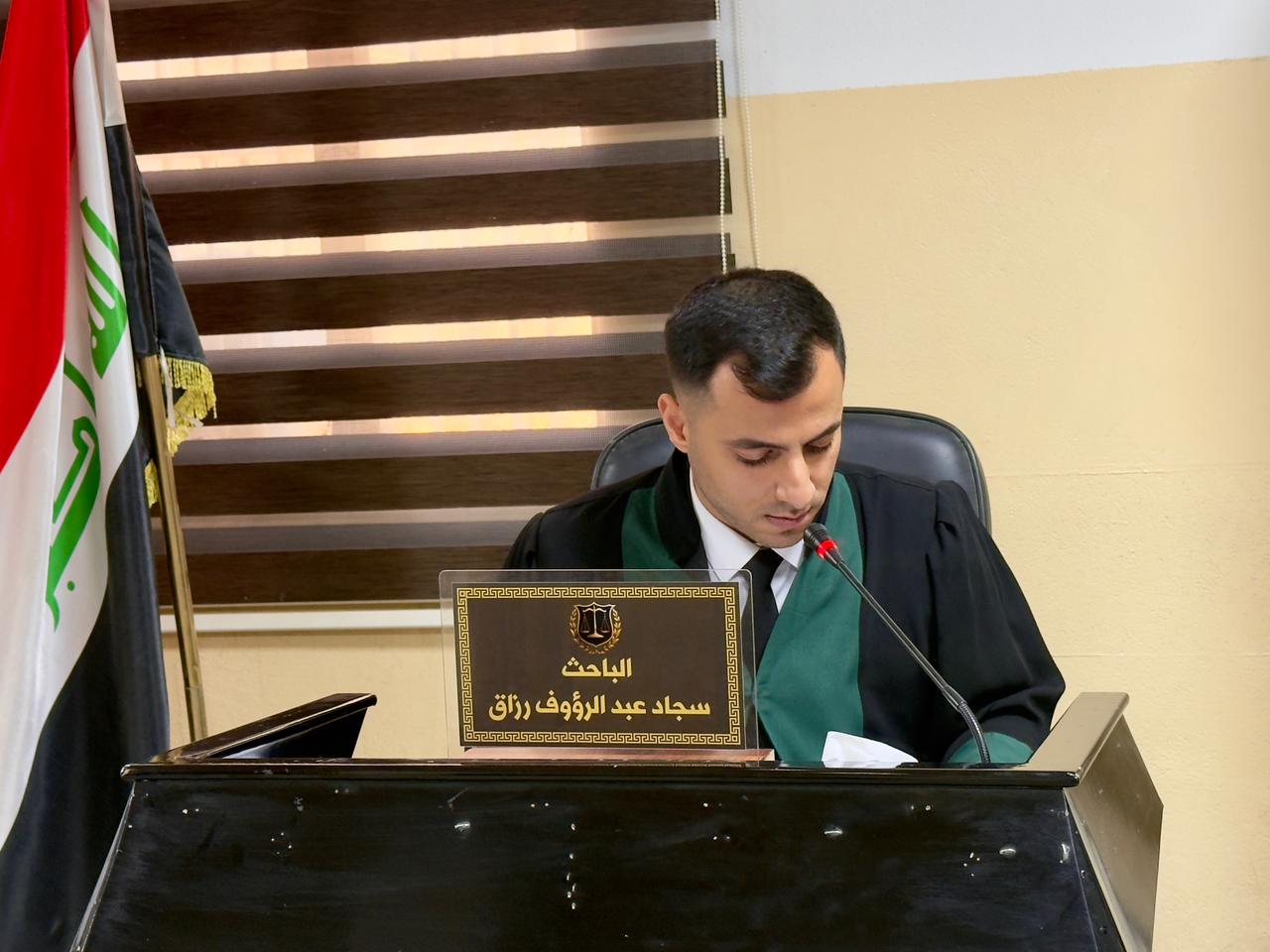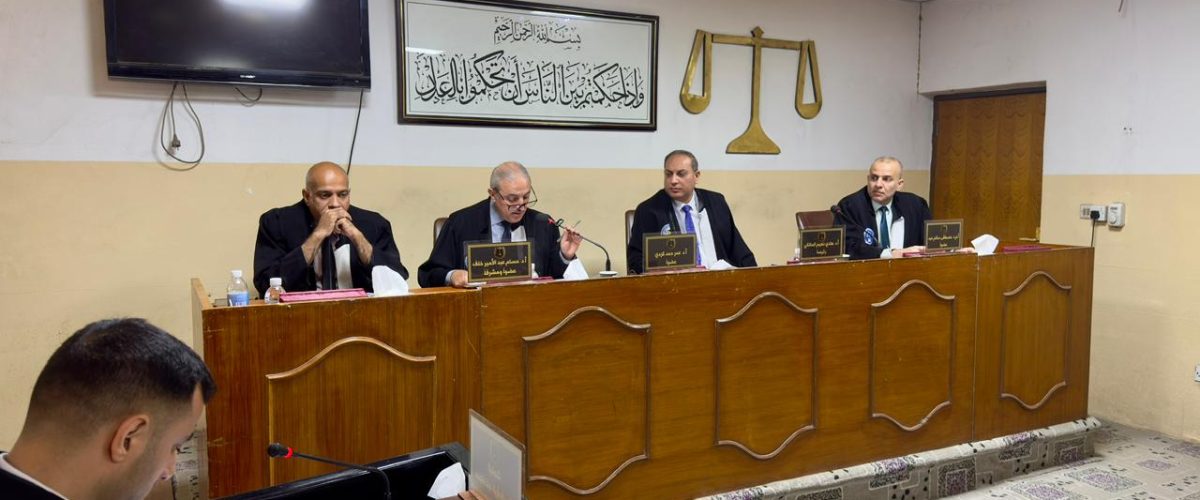

The College of Law at the University of Baghdad discussed a master’s thesis entitled “The International Legal Regulation of Nuclear Security”, submitted by Sajad Abdulraouf Razzaq in the Department of International Law, on Sunday, 24 May 2026, at the college’s Moot Court Hall.
The examination committee consisted of:
1. Prof. Dr. Hadi Naeem Al-Maliki (Chairman)
2. Prof. Dr. Omar Hamad Kurdi (Member)
3. Assist. Prof. Dr. Mustafa Salem Abd (Member)
4. Prof. Dr. Hussam Abdul Amir Khalaf (Member and Supervisor)
The thesis aims to address the challenges of nuclear security from both theoretical and practical perspectives. Theoretically, it seeks to bridge the knowledge gap created by fragmented approaches by presenting a comprehensive legal framework that integrates safeguards, safety, and disarmament within a unified structure. It also analyzes and conceptualizes the notion of “nuclear justice.”
The thesis is divided into three chapters. The first chapter examines the conceptual framework of nuclear security, the second discusses the mechanisms for achieving international nuclear security, and the third explores the fairness of the legal regulation of nuclear security and the challenges it faces.
The study concluded with several recommendations, the most significant of which are:
1. Redefining the concept of nuclear security as an independent concept through specialized studies that examine its conceptual, legal, and institutional dimensions, thereby advancing the discussion from mere translation and adaptation to theoretical contribution.
2. Harmonizing the fragmented rules contained in international treaties related to nuclear security and addressing existing legal gaps, including:
* Requiring nuclear-armed states to subject their military facilities and materials to the same physical protection standards.
* Defining cyber activities that may constitute an “armed attack” against nuclear facilities.
* Requiring nuclear-armed states to follow a specific and verifiable timetable for nuclear disarmament.
3. Establishing an international trust fund, financed through mandatory contributions from nuclear-armed states, dedicated to compensating victims of nuclear tests and accidents, rehabilitating contaminated areas, and supporting healthcare programs for affected populations.