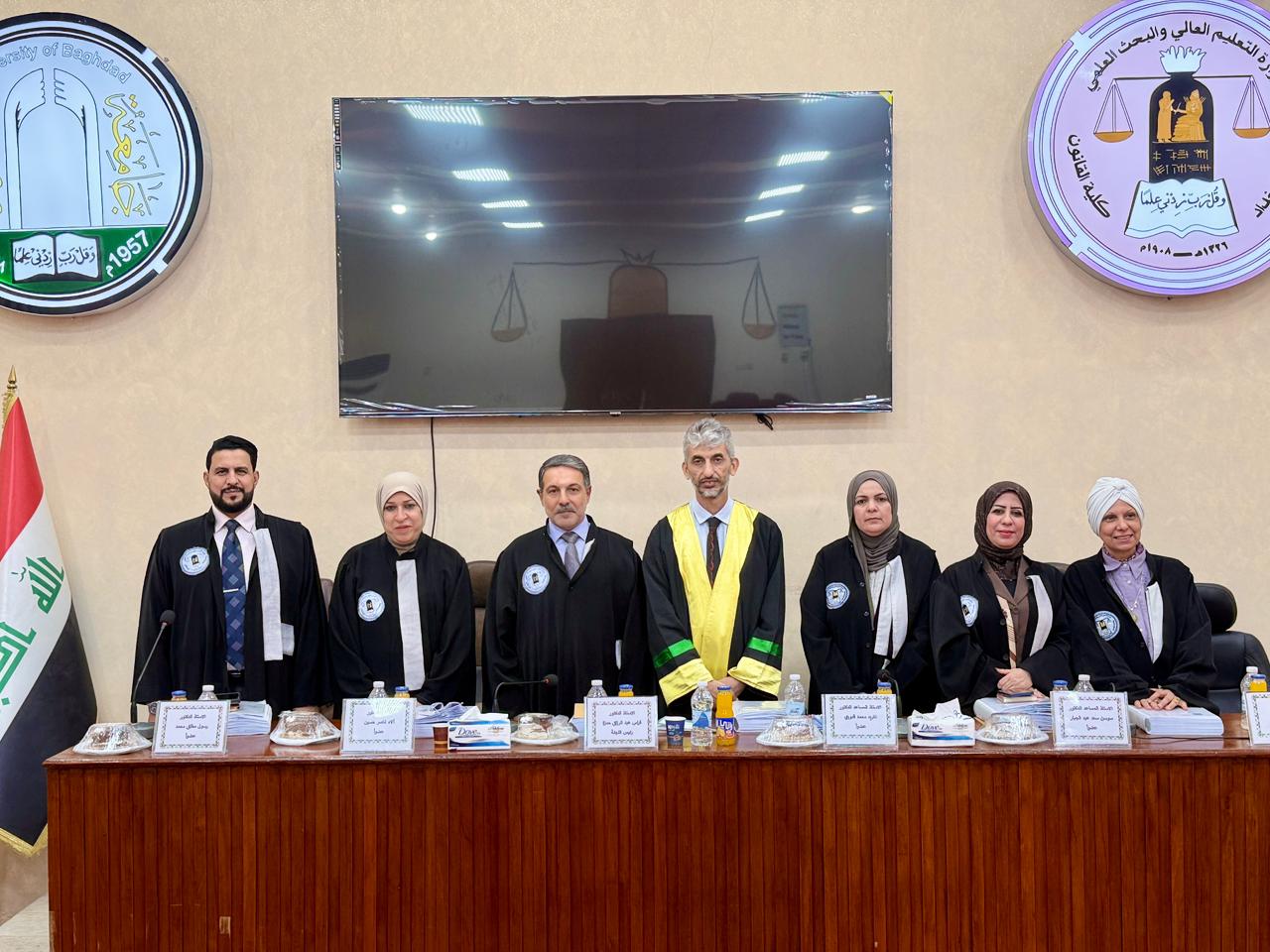
The College of Law – University of Baghdad discussed a PhD dissertation entitled “The Legal Regulation of the Rehabilitation of Inmates and Detainees in Correctional Institutions and Its Impact on Social Reintegration: A Comparative Study,” submitted by the student Dhari Matrood Jiyad in the Public Law, on Wednesday, 13 May 2026, in the Conference Hall of the College.
The examination committee consisted of the following professors:
1. Prof. Dr. Firas Abdul Razzaq Hamza – Chairman
2. Prof. Dr. Alaa Nasser Hussein – Member
3. Prof. Dr. Rasool Mutlaq Mohammed – Member
4. Assist. Prof. Dr. Taghreed Mohammed Qadoori – Member
5. Assist. Prof. Dr. Sawsan Saad Abdul Jabbar – Member
6. Prof. Dr. Saba Numan Rashid – Member and Supervisor
The dissertation aimed to shed light on the legal regulation of the rehabilitation of inmates and detainees in correctional institutions. It also sought to identify the shortcomings and negative aspects, as well as the positive aspects, of the Iraqi legislation governing rehabilitation and correction procedures, particularly the Law on the Reform of Inmates and Detainees No. (14) of 2018.
The dissertation consisted of two main parts. The first part addressed correctional institutions, while the second focused on the legal regulation of the rehabilitation of inmates and detainees.
The dissertation concluded with several recommendations, including:
1. Calling for the addition of a new paragraph to Article (23) of the law to read as follows: Article (23/Third): “An inmate or detainee who has reached the age of fifteen may be employed in state projects in exchange for a reduction in the duration of the custodial sentence, in addition to any reduction granted through conditional release.”
2. Proposing the establishment of new correctional centers to accommodate overcrowding in existing institutions, as this is considered one of the best solutions for reducing inmate numbers and improving the implementation of rehabilitation programs. The dissertation also recommended adopting modern alternatives used in more advanced legal systems, such as community service penalties, house arrest, electronic bracelet monitoring, and expanding the scope of financial penalties to include other crimes instead of imprisonment.
3. Calling for the opening of new vocational workshops, such as driving and car maintenance workshops, mobile phone and electronic device repair workshops, as well as programming workshops for inmates and detainees interested in learning digital and technological skills, since these professions have become essential requirements of the modern age.