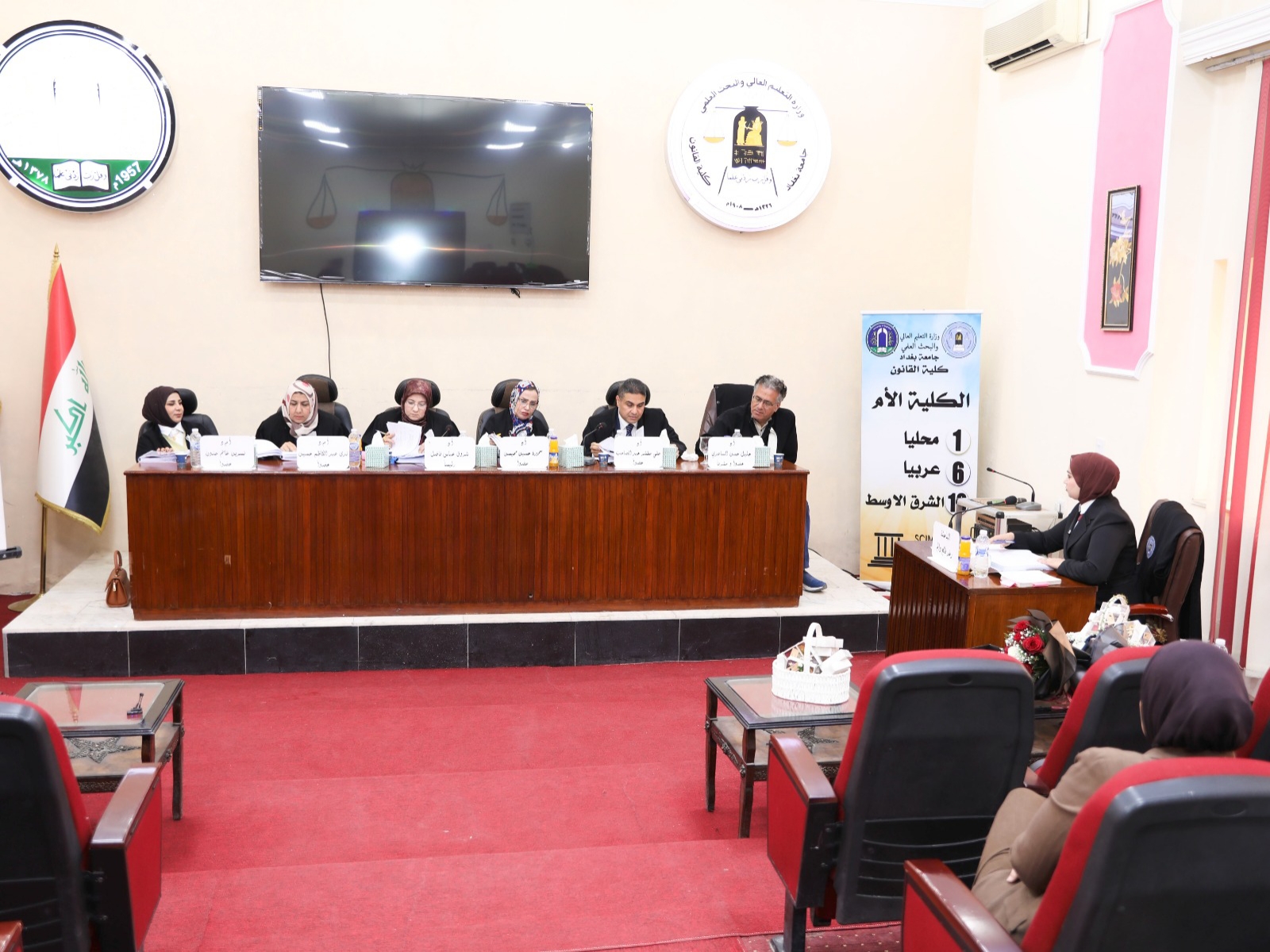
College of Law, University of Baghdad discussed a doctoral dissertation entitled “The Effect of Hardship in Contracts: A Study in Light of Article 1195 of the Amended French Civil Code, with a Comparative Study of English Law” by the student Raghad Faleh Dallam, in the Department of Private Law, on Thursday, 16 April 2026, in the college conference hall.
The examination committee consisted of:
1. Prof. Dr. Shorouq Abbas Fadhil (Chair)
2. Prof. Dr. Ali Muttashar Abdul Sahib (Member)
3. Prof. Dr. Samira Hussein Muhsin (Member)
4. Assist. Prof. Dr. Nada Abdul Kadhim Hussein (Member)
5. Assist. Prof. Dr. Nasreen Ghanim Hanoon (Member)
6. Prof. Dr. Jalil Hassan Al-Saadi (Member and Supervisor)
The study aimed to clarify the concept of hardship and its legal significance, analyze the legal issues arising from its effect on contracts, and examine judicial and jurisprudential efforts in addressing it. It also explored legislative approaches to hardship under the comparative legal systems, the extent of judicial authority to intervene in contracts, revise them, and adapt them to changed circumstances, ultimately leading to termination at the appropriate time and under conditions determined by the court.
The dissertation consisted of three chapters. The first chapter examined the nature of hardship in contracts, the second addressed determining the effects of hardship on contracts, and the third focused on remedies for contractual imbalance arising from hardship.
The dissertation concluded with several recommendations, the most important of which were:
First: The Iraqi legislator should amend Paragraph Two of Article 146 of the Civil Code by adding a remedial mechanism represented by renegotiation before resorting to litigation, similar to the French Civil Code.
Second: The court’s discretionary authority regarding the restoration of economic balance should be maintained, while amending the phrase “reduce the obligation to a reasonable extent” and granting the court broader options to restore economic balance.
Third: The proposed text should preserve its mandatory nature in order to strengthen the legal protection granted to contracting parties. Allowing exclusion of the proposed article may turn such exclusion into a standard contractual clause, thereby undermining the intended purpose of the remedy.