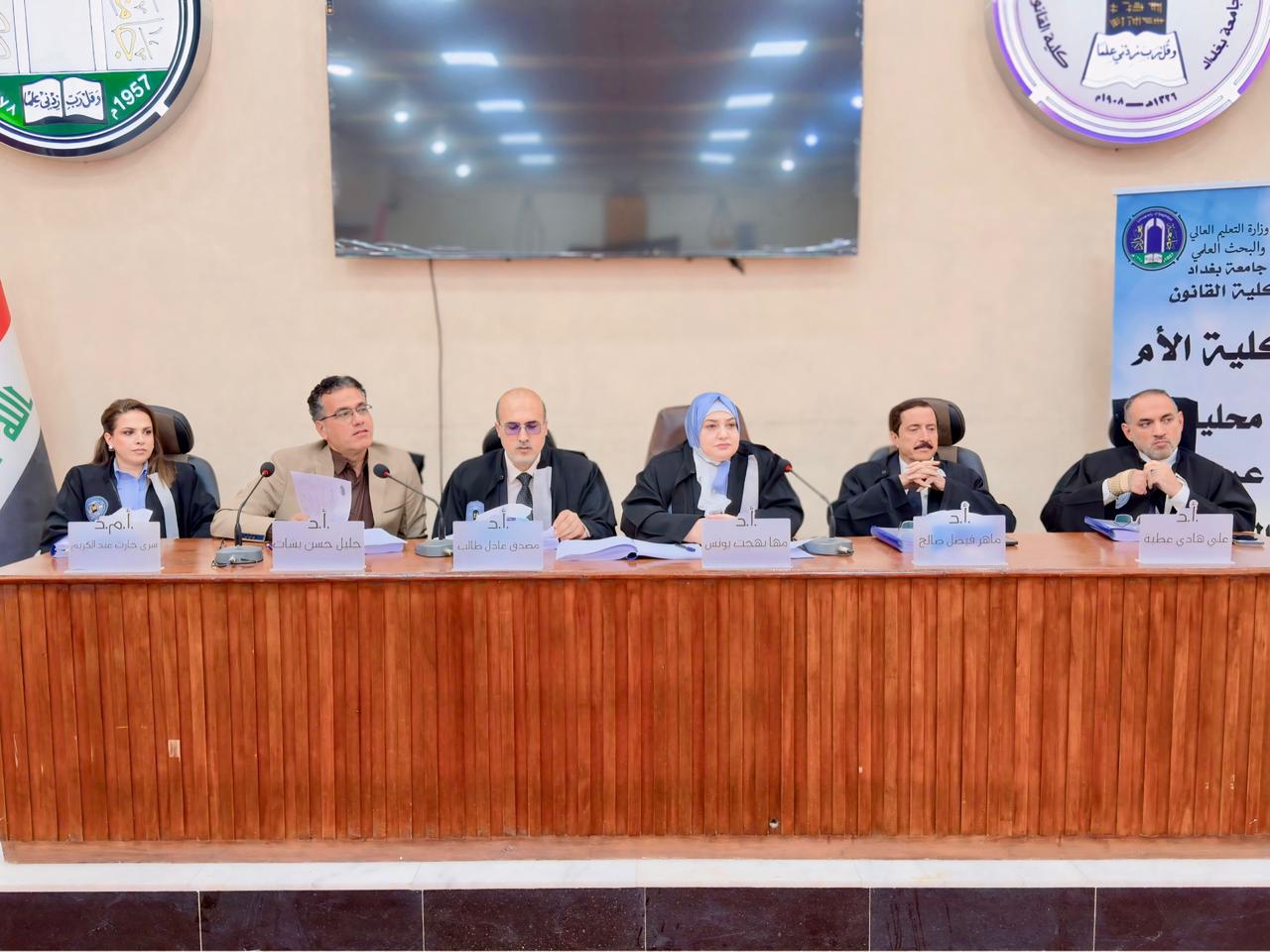
The College of Law at the University of Baghdad discussed a PhD dissertation entitled “The Complementary Jurisdiction of the Federal Supreme Court: A Comparative Study”, submitted by the student Shahad Hussein Mohammed from the Department of Public Law, on Tuesday, 17 March 2026, at the Conference Hall.
The examination committee consisted of:
1.Prof. Dr. Maha Bahjat Younis (Chairman)
2.Prof. Dr. Jalil Hassan Bashat (Member)
3.Prof. Dr. Maher Faisal Saleh (Member)
4.Prof. Dr. Musaddiq Adel Talib (Member)
5.Asst. Prof. Dr. Sura Harith Abdul Karim (Member)
6.Prof. Dr. Ali Hadi Atiya (Member and Supervisor)
The study aimed to clarify the concept of the “complementary jurisdiction of the Federal Supreme Court” and its potential impact on the scope of the Court’s authority. It also examined the philosophical foundations and justifications behind establishing such jurisdiction. Furthermore, the study explored how the independence of the Federal Supreme Court influences its ability to develop complementary jurisdiction, and identified the mechanisms and legal bases through which this jurisdiction can be established and consolidated. The dissertation also attempted to reconcile adherence to constitutional limits on the Court’s powers with the necessity of establishing complementary jurisdiction in response to evolving legal and societal needs.
The dissertation consisted of three chapters:
•Chapter One addressed the conceptual framework of the complementary jurisdiction of the Federal Supreme Court.
•Chapter Two examined the impact of the Court’s independence on the emergence of its complementary jurisdiction.
•Chapter Three discussed the forms and procedures of exercising this complementary jurisdiction.
The dissertation concluded with several key recommendations, including:
•First: There are procedures related to the Court’s competencies that it may undertake even without explicit legal provisions; therefore, it is recommended to legislate a full chapter dedicated to the complementary jurisdiction of the Federal Supreme Court within its governing law.
•Second: It is proposed to introduce a specific legal provision concerning the tools of the constitutional judge, allowing them to derive procedural rules in cases where legislation is absent, incomplete, or outdated.
•Third: It is recommended to modify the principle “no ijtihad (interpretation) in the presence of a text” to be understood as “no in the presence of a clear and complete legal text.”