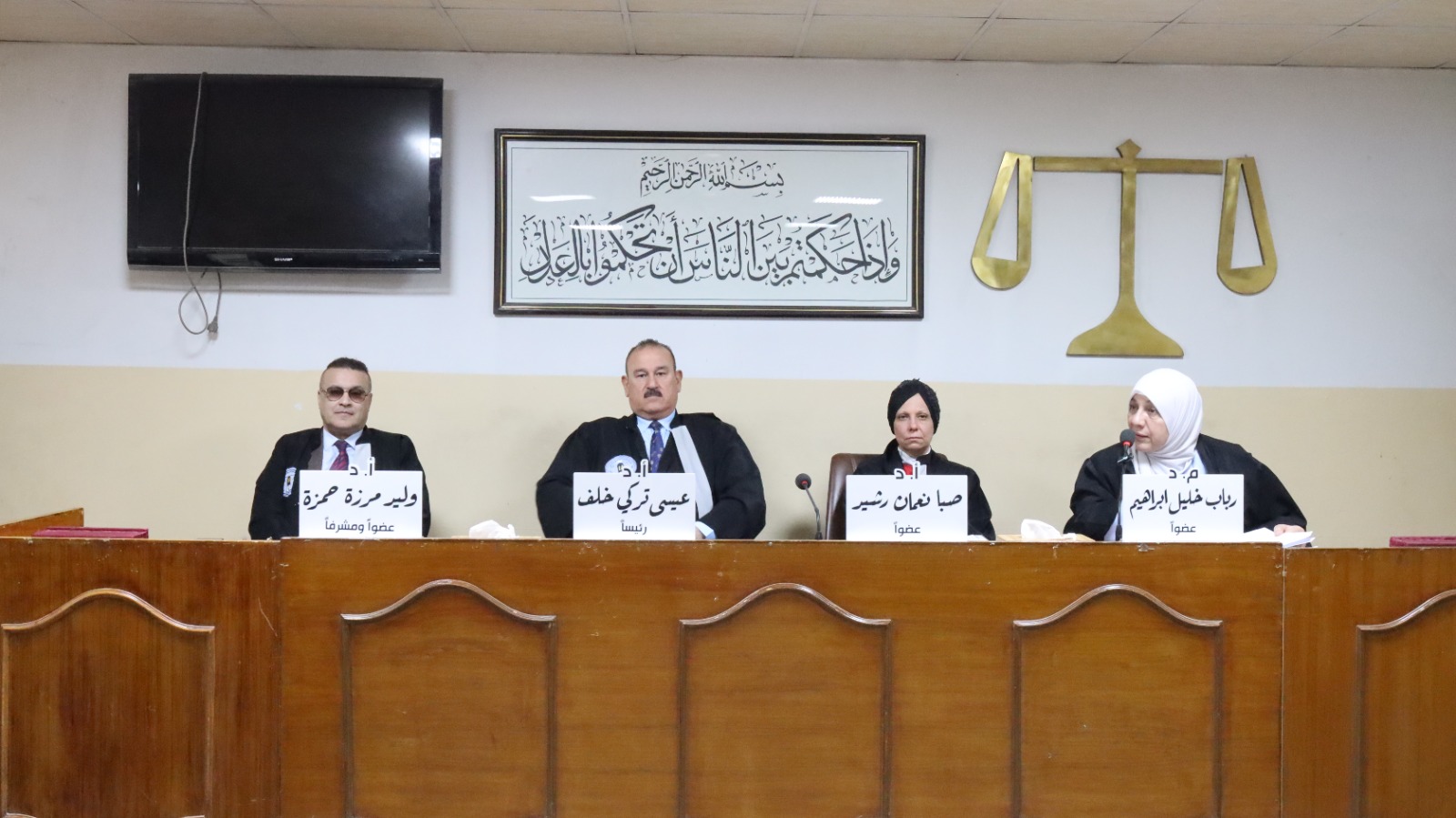
The College of Law – University of Baghdad discussed a Master’s thesis entitled “The Principle of Sustainable Non-Discrimination and Its Applications in Iraqi Administrative Law: Women and Minorities as a Model” by the student Iman Kazim Jabbar, from the Department of Public Law, on Wednesday 25/2/2026, in the Model Court Hall.
The examination committee consisted of the following professors:
1.Prof. Dr. Issa Turki Khalaf (Chair)
2.Prof. Dr. Saba Numan Rasheed (Member)
3.Lecturer Dr. Rabab Khalil Ibrahim (Member)
4.Prof. Dr. Waleed Mirza Hamza (Member and Supervisor)
The study aimed to demonstrate the importance of the principle of non-discrimination in international conventions and national legislation by promoting gender equality and protecting marginalized groups, including minorities as individuals and communities, as well as highlighting social gaps.
The thesis consisted of three chapters:
The first chapter discussed the concept of the principle of non-discrimination and its relationship to sustainable development.
The second chapter examined the legal basis of the principle of sustainable non-discrimination.
The third chapter addressed the mechanisms for implementing the principle of sustainable non-discrimination.
The thesis concluded with several recommendations, the most important of which include:
First: Amending Article (14) of the Iraqi Constitution of 2005 by adding the phrase:
“The State shall commit to making the prohibition of discrimination a sustainable principle in all its policies, to be regulated by law.”
Second: The necessity of preparing a special legislative code for women’s laws through a dedicated survey of the most important legislations, particularly administrative ones, focusing on shortcomings and weaknesses, followed by analyzing and identifying legal gaps in preparation for amendment.
Third: The proposal to establish specialized courts or to train and qualify judges of administrative or ordinary courts to address prohibited discrimination cases in the public sector, ensuring the existence of a specialized judiciary that adjudicates complaints objectively, fairly, and professionally in order to implement non-discrimination standards in Iraq.